Deep inside the Church of Santa Maria del Popolo in Rome, Italy, hangs one of Caravaggio’s masterpieces, a painting that captures on canvas a powerful beam of light pouring into pitch-black darkness. The work, titled The Conversion of Saint Paul on the Road to Damascus, contrasts Saul, fallen from his horse with his eyes closed, with the ordinary figures standing nearby, unaware of the cosmic upheaval taking place within him. Across this canvas flows a heavy silence about how a great heavenly event overturns the inner world of a single human being. Pastor David Jang’s sermon begins by tracing the immense movement hidden behind this silence: the providence of God, unseen by our eyes yet ceaselessly pulsing. When we read Scripture not as dead letters but as a spiritual presence breathing beside us at this very moment, we finally pass beyond the surface of religion and enter the depths of grace.
“My Father is working until now, and I am working.” This declaration in the Gospel of John is not merely an exhortation to diligence, but a theological compass that reveals the trajectory of eternal life flowing beneath human daily life. The movement of the Word stops us for a moment on the busy surface of life and leads us to turn our eyes toward the world behind it, beyond ordinary dimensions. In every hour of daily life, as we plan, converse, and alternate between achievement and failure, God is in fact moving first, and our steps are aligned upon the holy waves of His action. This deep insight lifts faith beyond blind moral determination and transforms it into the joy of partnership, gladly joining in the work of God. Ministry is not helping God by my own strength; it is recognizing the hand of the One who is already at work and placing my life within that flow.
When Light Divides the Darkness, the Hidden Realm of Grace Opens
The story of Saul in Acts 9 bears the most powerful witness to how this hidden realm breaks through the closed doors of human life. Saul was a firm and unyielding man, trapped within his religious convictions and justifying violence and imprisonment against the church. Yet his murderous steps toward Damascus were brought to a complete halt before the heavenly light that fell like lightning. The Lord’s voice—“Saul, Saul, why are you persecuting Me?”—dismantled his arrogant reason in an instant and became a fatal calling that shook the very foundation of his existence. The place illuminated by this sermon is precisely this overwhelming moment of grace. Conversion is never accomplished by human self-discipline, no matter how severe, nor by mere intellectual agreement. Though it cannot be understood by human calculation or common sense, the gospel is this unilateral event of salvation in which God first seeks out the enemy of the church and covers him with His light.
Saul’s darkness, in which he lost his sight and neither ate nor drank for three days, was not simply a time of physical shock or pain. It was a holy labor pain that had to be endured so that his old certainties could collapse completely and a new dimension of life could begin to be born within him. Like the vast narrative of conversion painted by Michelangelo on the wall of the Pauline Chapel in the Vatican, Saul’s fall was more than personal moral improvement; it was the manifestation of revelation that bent the direction of history itself, an ontological transformation. At the very moment when the vain will to control the course of my own life is broken, the true door of life opens. The gospel is a paradoxical love that first breaks us down completely and then raises us again with the life of heaven.
Providence That Redirects the Path of Calling and the Rhythm of Obedience
God’s drama of salvation is not completed through the dramatic transformation of one person alone. It expands into history through another obedience, silently prepared in an unseen place. While Saul was moving into earnest prayer in the darkness, the Lord called an unnamed disciple named Ananias on the other side of the stage. Ananias was not remembered for some great achievement, yet he possessed a deep intimacy that enabled him to respond immediately to the Lord’s call: “Here I am, Lord.” This meditative passage reminds us that ministry is ultimately not labor that proves grand accomplishments, but a spiritual navigation that responds immediately to the Lord’s delicate voice. God knows precisely the name of a person, the street where he stays, and even the weary condition of his soul. In the mystery of providence and predestination, as Calvin described it, God perfectly connects the paths of two people.
Of course, a person of faith is not a robot who obeys mechanically. Ananias, too, pours out his fear-filled protest toward Saul, who had persecuted the church. Yet the Lord does not suppress him. Instead, He persuades him into a deeper dimension of His plan, saying, “This man is My chosen instrument.” He teaches that behind the glory of the one who is called, the burden of suffering is always attached like the other side of the same coin. When Ananias moves beyond fear, lays his hands on Saul, and calls him “Brother Saul,” the old common sense of the world collapses, and the shalom of heaven penetrates history. In this way, Pastor David Jang’s message weightily illuminates how each small act of obedience we carry out in daily life is connected to the great movement of the kingdom of God. Partnership is not a grand title; it is a relational act of offering oneself to the flow of the Lord. Only then do we come to confess with true power, “The Lord is the One who does it.”
The Horizon of the Gospel That Comes Where Boundaries Collapse
As we move into Acts 10, the work of the Holy Spirit, who tears down hardened human boundaries, unfolds even more clearly. Cornelius, a Roman centurion, was a Gentile and a man who carried the sword of the empire, yet Scripture describes him as one who feared God, gave generously, and prayed continually. This powerfully proves that the gospel can never be confined within the boundaries of a particular bloodline or the fence of the law. The scene in which an angel appears to Cornelius and tells him that his prayers have ascended to heaven shows that our concrete prayers are real events that move the throne of God. Evangelism is not a technique for subduing another person with sophisticated logic. Rather, it is a trembling process of standing before the longing of a soul that God has already cultivated, while honoring that longing. Though Cornelius stood at an unfamiliar boundary outside the church, God first sought out this man whose heart remained open, guiding him through the navigation of providence.
At the same time, Peter also experiences a vision of the heavens opening while praying at the appointed hour on a rooftop in Joppa. Peter’s resistance before the command to kill and eat unclean animals—his attempt to preserve the boundary of the law as if it were life itself—is shattered before the solemn declaration repeated three times: “What God has made clean, do not call common.” Like the devout trembling of Peter in the darkness as depicted by Domenico Fetti, this moment, in which an old religious identity is dismantled and transplanted into a wider horizon of salvation, is both painfully severe and dazzlingly blessed. The dramatic timing in which the men sent by Cornelius arrive at the door just as Peter’s inner collapse comes to an end reveals the perfect rhythm of partnership, where one person’s devotion, another person’s obedience, and another person’s sending are joined together with the command of heaven.
A Confession Toward Holy Daily Life: We Are All Here Before God
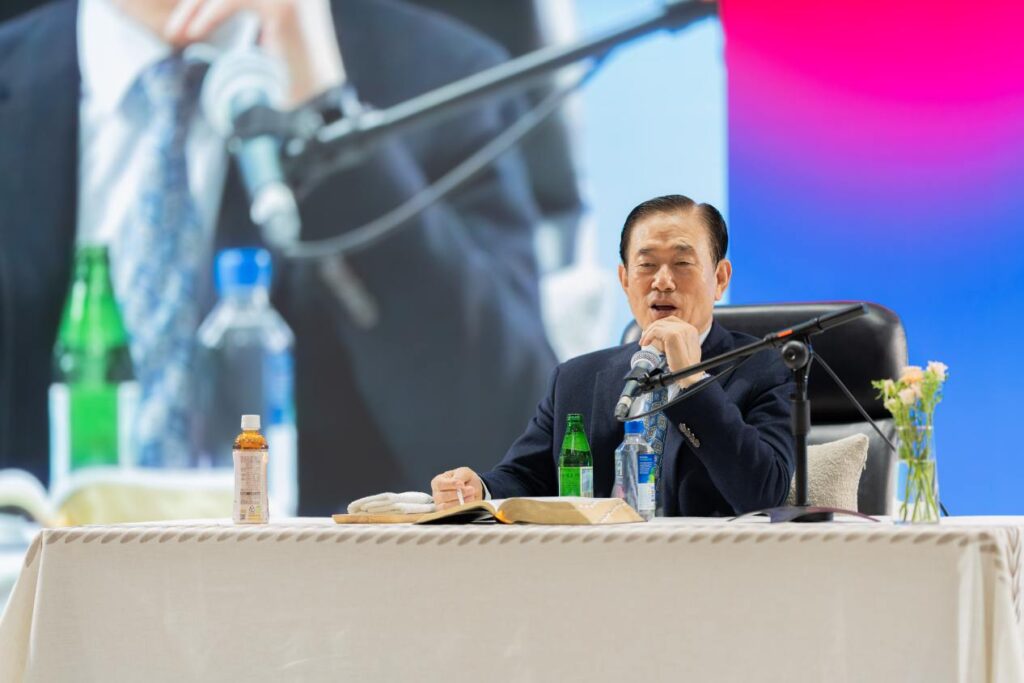
When Peter entered the house of Cornelius, the centurion who held imperial authority fell down and bowed before the old fisherman from Galilee. But Peter quickly raised him up and replied, “Stand up; I too am a man.” It was the moment when worldly human hierarchy collapsed completely and a holy order was established in which only God is exalted. Overwhelmed with emotion, Cornelius confessed, “Now we are all here in the presence of God to hear all that you have been commanded by the Lord.” The conclusion of Pastor David Jang’s sermon moves toward precisely this solemn and beautiful place. Our gatherings, our encounters, and our small labors are never desperate struggles to prove our achievements before people. They are holy worship and a journey of obedience in which we offer our whole existence before the invisible Eternal One.
Faith, in the end, is living with both fear and fascination, even in the smallest cracks of life, knowing that “God is watching.” Prayer at fixed hours is not a legalistic compulsion to match the clock, but the breath of life by which we draw the antenna of the soul away from the noise of the world and tune it again to the frequency of heaven. Our reverence is proven from the small sincerity of choosing a single flower to place in the sanctuary, or from the fingertips that seek to set apart the first things and offer them to God. When we intentionally stop amid busy work and tangled relationships to look up toward heaven, our scattered and broken daily life is finally woven beautifully into one meaningful covenantal narrative. When we are assured of the Father’s hand working behind countless coincidences, our steps are no longer lonely wandering, but holy companionship. Among the many people and busy tasks you clearly face today, whose instruction is your inner being truly waiting for? In that quiet and honest place where we kneel and break our vain stubbornness, the closed door of heaven will once again begin to open silently.